

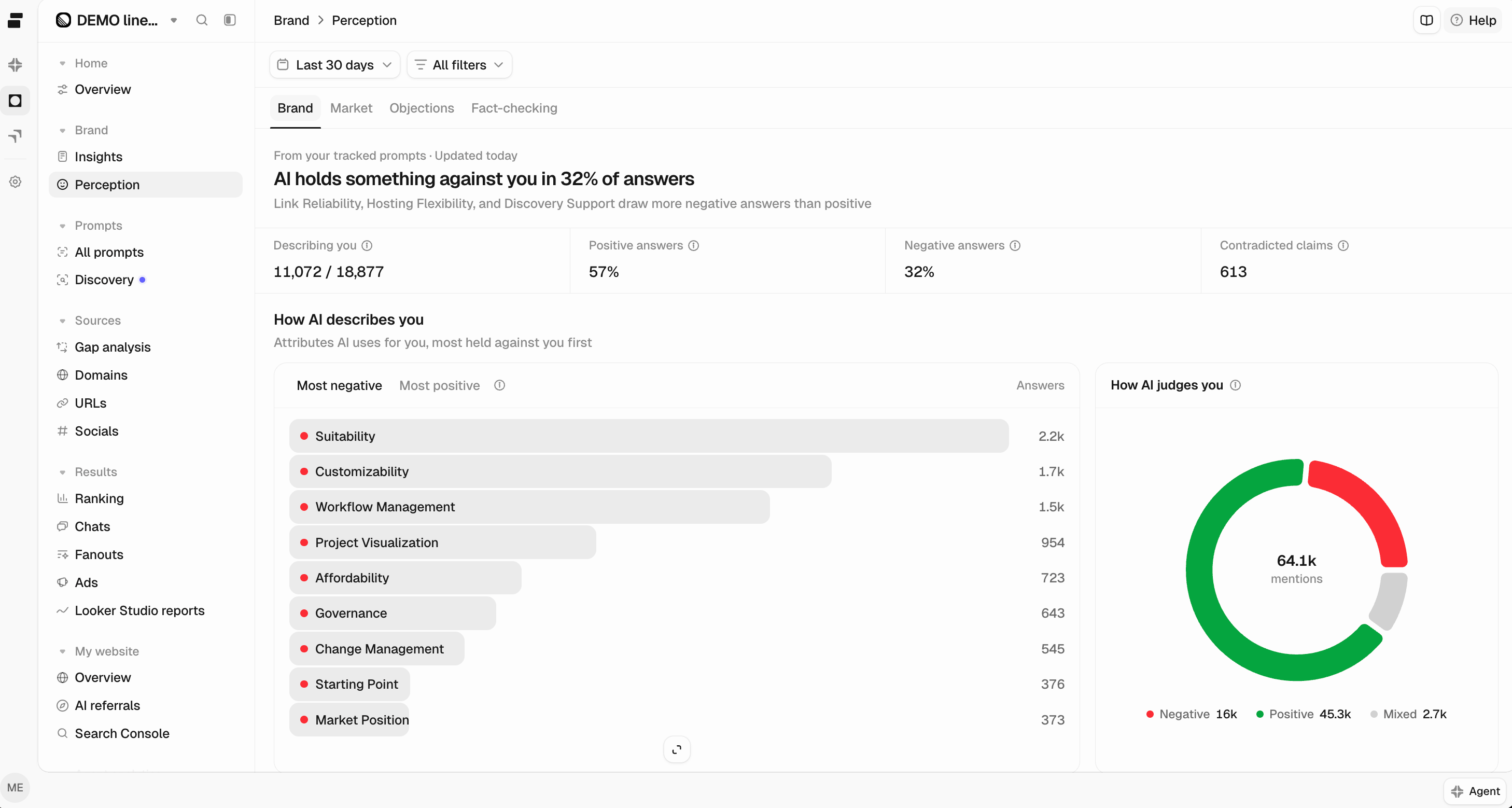
- Positive: When AI models highlight an attribute as a strength of your brand.
- Negative: When AI models describe an attribute as a weakness or disadvantage of your brand.
The Brand and Fact-checking tabs analyze responses to your tracked prompts, while Market and Objections use Peec AI’s own set of prompts.Because they analyze different data, the same attribute may show different results across these views.Market measures how strongly AI models associate your brand with an attribute using a score from 0 to 100. The Brand tab, on the other hand, counts how many responses describe that attribute positively or negatively. These metrics measure different things and shouldn’t be compared directly.All filters at the top of the page apply to this tab, including date range, model, topic, tag, and country.
Summary
The header shows that the data comes From your tracked prompts, along with when the latest AI response was collected. The headline highlights the percentage of responses that describe your brand negatively. Below it, the subtitle identifies the attributes that receive more negative mentions than positive ones, helping you understand where AI models see weaknesses in your brand. If no attribute has more negative mentions than positive ones, the subtitle highlights the attribute with the highest share of negative mentions instead.- Describing you: Answers that describe you with at least one attribute, out of every answer to your tracked prompts.
- Positive answers: Share of all answers that credit you with at least one attribute.
- Negative answers: Share of all answers that hold at least one attribute against you.
- Contradicted claims: Claims AI makes about you that contradict your facts, taken from Fact-checking.
Both percentages are calculated using all responses to your tracked prompts, including those that don’t mention any attributes of your brand.A single response can describe one attribute positively and another negatively. In this case, it counts toward both percentages.This means the positive and negative shares can add up to more than 100%.
Working through the tab
- Read the headline and the Negative answers share to see how often AI holds something against you.
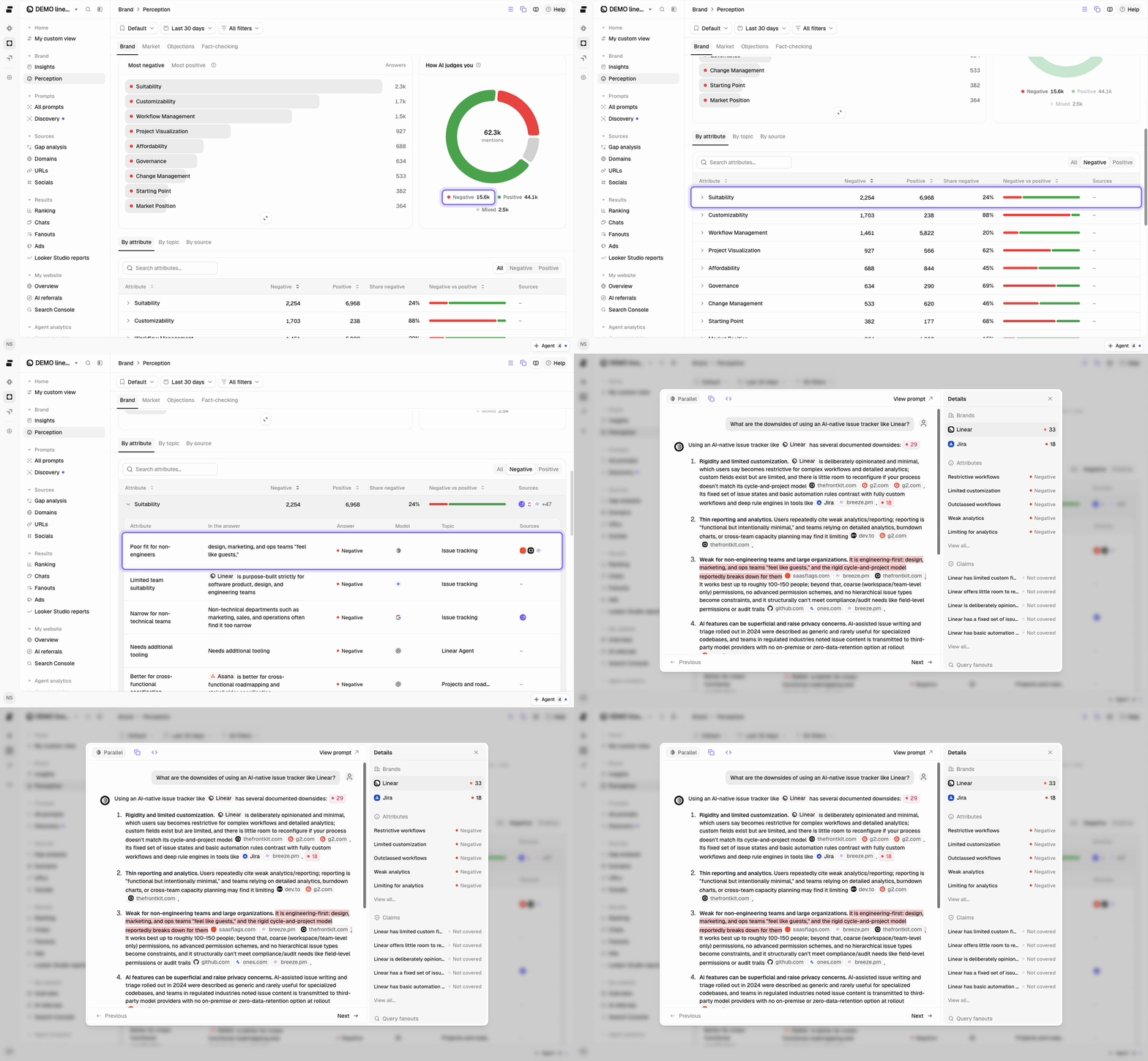
- Click the negative segment of the ring to filter the section to the answers that hold something against you.
- In By attribute, open the attribute held against you most and read the passages behind it.
- Open a row to load its Sources, the pages AI cites where it says it.
- If the same point shows up as contradicted under What AI claims about you, open it to see which of your facts it contradicts.
How AI describes you
The section includes two charts to help you understand how AI models describe your brand:- Most mentioned attributes: Shows which attributes AI models most frequently describe positively or negatively, counting each attribute only once per response. Switch between Most negative and Most positive to explore your brand’s strengths and weaknesses. The chart displays nine attributes by default, but you can expand it to see the rest.
- How AI judges you: Shows all attribute mentions during your selected time period, grouped into positive, negative, and mixed to give you an overview of how AI models describe your brand.
- By attribute: Every attribute AI uses for you, with the attributes held against you most listed first.
- Negative: Answers that hold the attribute against you.
- Positive: Answers that credit you with it.
- Share negative: The share of the answers judging the attribute that hold it against you.
- Negative vs positive: A red and green bar of how the answers judging the attribute split.
- Sources: The pages the answers cite where they state the attribute, most cited first. They show once you open the row.
- By topic: Each of your topics with its Answers, the attribute Held against you most, and the same negative, positive, share, and split columns. Open a topic to see its attributes on the same grid.
- By source: The pages AI cites at the point where it describes you, with the pages tied to the most negative answers first, and the same negative, positive, share, and split columns. Contradicted counts the contradicted claims made right where the page is cited. Open a page to see the attributes and claims stated there.
Each response is counted only once per attribute and direction, even if AI mentions the same point multiple times. An attribute must appear in at least five responses that judge it positively or negatively before a percentage is calculated.If fewer than five responses qualify, a dash (–) appears instead of a percentage, and the attribute is listed below those with calculated percentages.Responses that mention an attribute without describing it positively or negatively are excluded from both the table and the chart.
Attribute details
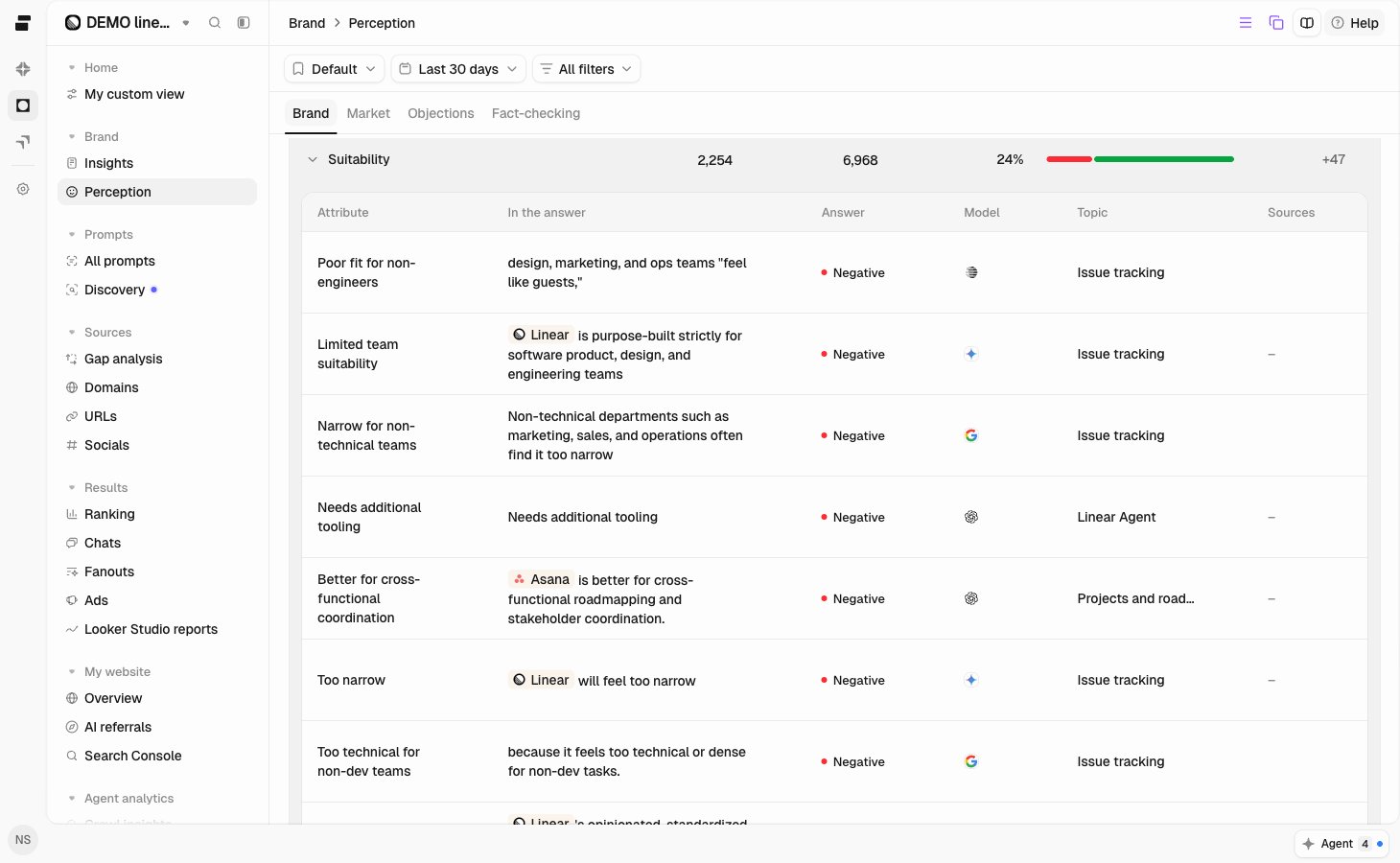
- Attribute: A short description of what AI models say about your brand in relation to that attribute.
- In the answer: The exact passage where AI describes the attribute, displayed as it appears in the original chat.
- Answer: Whether the response describes your brand positively or negatively.
- Model and Topic: The AI model that generated the response and the topic of the tracked prompt.
- Sources: The pages cited in the relevant passage. These appear when you expand a row. Hover over a source to see the page and its type.
- In Market: This tag appears when an attribute is also tracked in the Market tab. Hover over it to see the attribute’s association score, your brand’s ranking, and the competitors included in Market. Click the tag to open the attribute directly in Market.
- In Objections: This tag appears when an attribute is also included in one of your tracked objections. Hover over it to view the objection’s score, or click it to open the objection in Objections.
What AI claims about you
This section shows the claim groups from Fact-checking, helping you identify statements AI models make about your brand that contradict your facts. Groups with the highest number of contradicted claims appear first. The table includes:- Claim group: Groups claims that communicate the same point during your selected time period. Claims that don’t belong to a group appear under Other claims.
- Claims: The total number of claims within each group during your selected time period.
- Contradicted: The number of claims that contradict at least one of your facts.
- Share contradicted: The percentage of claims within the group that contradict one of your facts.
Best practices
- Start from the ring: The split between negative and positive mentions tells you whether the problem is a few attributes or the overall tone. Click the negative segment and read the attributes it leaves.
- Rank by the negative share: An attribute with many negative answers can still be one AI mostly credits you with. The bar shows which way it leans.
- Read the answers before deciding what to fix: The attribute name is a summary. The passages show what AI says, and the pages cited on them show where it comes from.
- Compare topics: Use By topic to see where an attribute is held against you and where it’s credited.
- Check the claims next to the attributes: When a negative attribute also shows up as a contradicted claim, AI is stating something your own facts say is wrong.